How to choose a fence by material
Choosing a fence gets simpler if, instead of leafing through a catalogue, you start with four questions: what the fence should hide, how much time you want to give it, how steep the plot is and what will be seen from the street.
Start with the job, not the material
A fence can do four different things and each leads to a different material. Marking a boundary is handled by the cheapest mesh. Blocking the view is done by timber, concrete or a gabion. Holding back noise is a question of mass, so a gabion or masonry. And looking representative is usually metal or timber with a carefully chosen finish. Most plots need all four, but each on a different side.
Timber
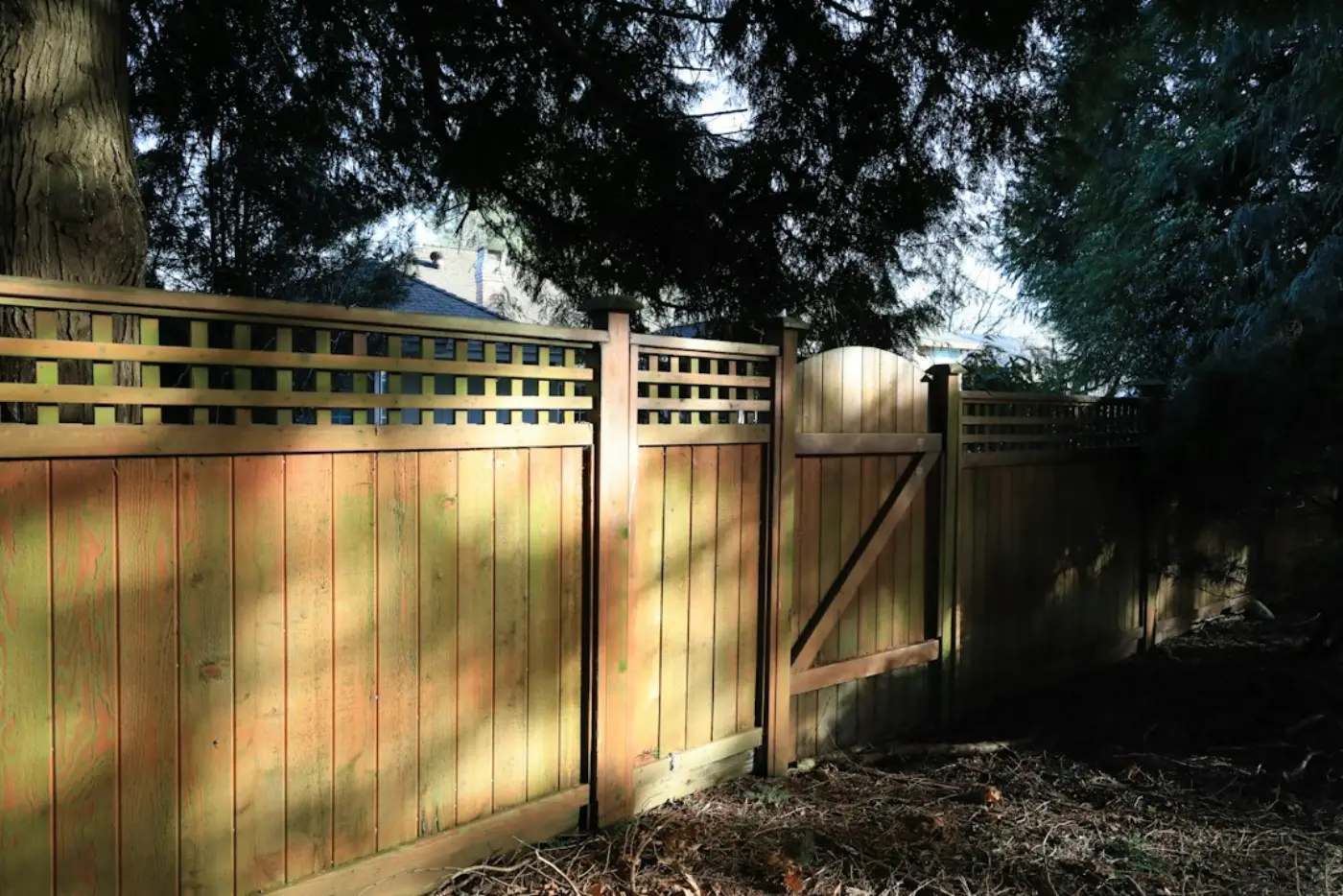
The most variable material and also the one that asks for the most attention. The gap between boards can be set from almost open to fully solid, the species can be chosen for durability and the shade can be changed at any time. In exchange there is a finish to renew in cycles and a heightened sensitivity to how the fence is founded. Timber touching soil ages incomparably faster than timber with air underneath it.
Mesh and welded panels
Plastic-coated mesh is the most economical way to close a long boundary. It has one property no other material has: on a slope it follows the ground smoothly and does not have to be stepped. A welded 3D panel looks tidier and holds its shape without a tension wire, but on a slope it has to be stepped panel by panel. Both are practically maintenance free.
Metal
Metal fence units give a fence a shape that lasts. Slats can be made semi-open or solid and the gate comes in the same design, so the entrance does not look stuck on. The demanding part is the surface finish: a well-made finish lasts a long time, a poor one starts showing at cuts and welds.
Gabion
A basket of stone is solid, practically maintenance free and heavy. That mass is both its main advantage and its main complication: it damps noise and retains a slope, but it needs a footing that can carry it. We do not build gabions; it is listed here to make the comparison complete.
Concrete
Concrete fence units are the quickest way to build a solid boundary with nothing to paint. They are heavy, so the foundation decides here too, and on a slope they are stepped unit by unit. Compared with stone solutions they take up less width. There is more in the article Turnkey concrete fence.
Four questions that settle the choice
What should the fence hide? If nothing, mesh is enough. If it is the view from the street into your living room, you need a solid infill.
How much time will you give it? Painting timber is regular work. If you know you will not get round to it, choose a material that is not painted.
How steep is the plot? A steep slope changes a quote more than the choice between timber and metal, because every step is another post.
What will be seen from the street? The street side can carry a more expensive material, because there is little of it. On the back boundary the same money disappears without any effect.
A table comparing all five materials side by side is on the home page.