Wicket gates and driveway gates
A wicket gate and a driveway gate are the only moving parts of a fence. That is where a mistake in the post foundations shows up first.
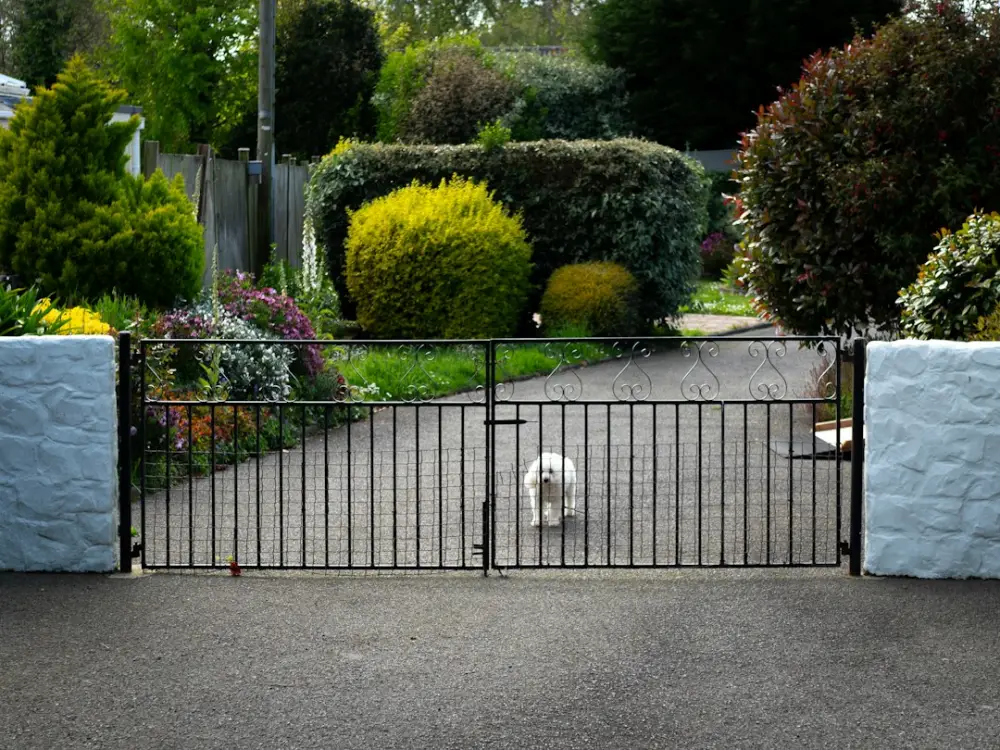
A wicket gate is the way in for people, a driveway gate the way in for a car. Both hang on posts that carry a different load from the posts of a fence panel, so they are founded deeper and more solidly. That is the most common hidden difference between two quotes that otherwise look the same.
Swing or sliding gate
A swing gate is simpler and cheaper, but it needs the space the leaves open into. Where the plot rises towards the gate it often does not work and the leaf scrapes the ground.
A sliding gate runs sideways on a guide track, or cantilevers. It needs clear space beside the entrance roughly as long as the gate, and in the cantilever version a substantial footing. In exchange it does not mind a slope or a car parked right behind it.
The drive is dealt with before concreting
If the gate is to be powered, the electricity supply and a conduit under the drive have to be in place. Both are done before the posts are concreted in and the driveway surface is finished. Pulling a cable under finished paving afterwards is unnecessary and unpleasant work. That is why we ask about a drive even when you do not want one yet: laying a conduit is enough and the decision can wait.
Locks, doorbell and letterbox
With a wicket gate the questions are the type of lock, whether there should be an electric release, and where the doorbell and letterbox go. On metal gates these are built into the frame or the post; on wooden ones they are more often handled by a separate post. It is a detail that is harder to add once the fence is finished than you would expect.
Matching the fence
A gate should follow the infill of the fence so that it does not look like a foreign object. With metal fences this is straightforward, because the maker supplies a gate in the same design. With a wooden fence the same boards go into the gate frame as into the panels, only the frame is braced diagonally against sagging.
What to tell us
- The width of the entrance and how you drive into it
- Whether you want a swing or a sliding gate
- A drive: yes, no, or preparation only
- How many wicket gates and where
- Whether the paving at the entrance is already finished
- The fence material the gate should match
We do not recommend estimating the gate width from a photo. It is set during the survey, based on how the entrance is actually approached.
Dealing with the whole boundary including the entrance? Carry on to turnkey fencing of a whole plot.
Frequently asked questions
How wide should a driveway gate be?
It follows from how the entrance is approached. A gate you drive straight into can be narrower than one you have to turn into from a narrow street. Because this cannot be judged from a photo, the width is set during the survey on site.
Can a drive be added later?
It can, provided the electricity supply and a conduit under the driveway are ready and the gate is rated for a drive. Without that preparation it means cutting into a finished surface. That is why a conduit is laid even when no drive is being bought yet.
Who arranges the electrics for the gate?
It depends on the arrangement with the company building the fence. Some teams do it themselves, others take over a supply prepared by an electrician. Tell us in the enquiry whether you have your own electrician or whether it should be part of the delivery.
Tell us the length of your fence
An approximate length, the height you want and whether the plot slopes is enough to start. We will fill in the rest.
We pass the enquiry to a fencing company that works in your area. If we have no partner there, we will tell you straight away instead of leaving you waiting.
Phone: 775 654 443
E-mail: info@oploceni-na-klic.cz